Surface Preparation
Remove bonded contamination so the protective phase can contact the actual surface rather than contamination sitting above it.
Koenig’s working model for describing how proper decontamination exposes the microscopic surface profile so a fine Carnauba protective phase can conform closely to it, interact intimately with surface irregularities, and form a continuous protective interface.
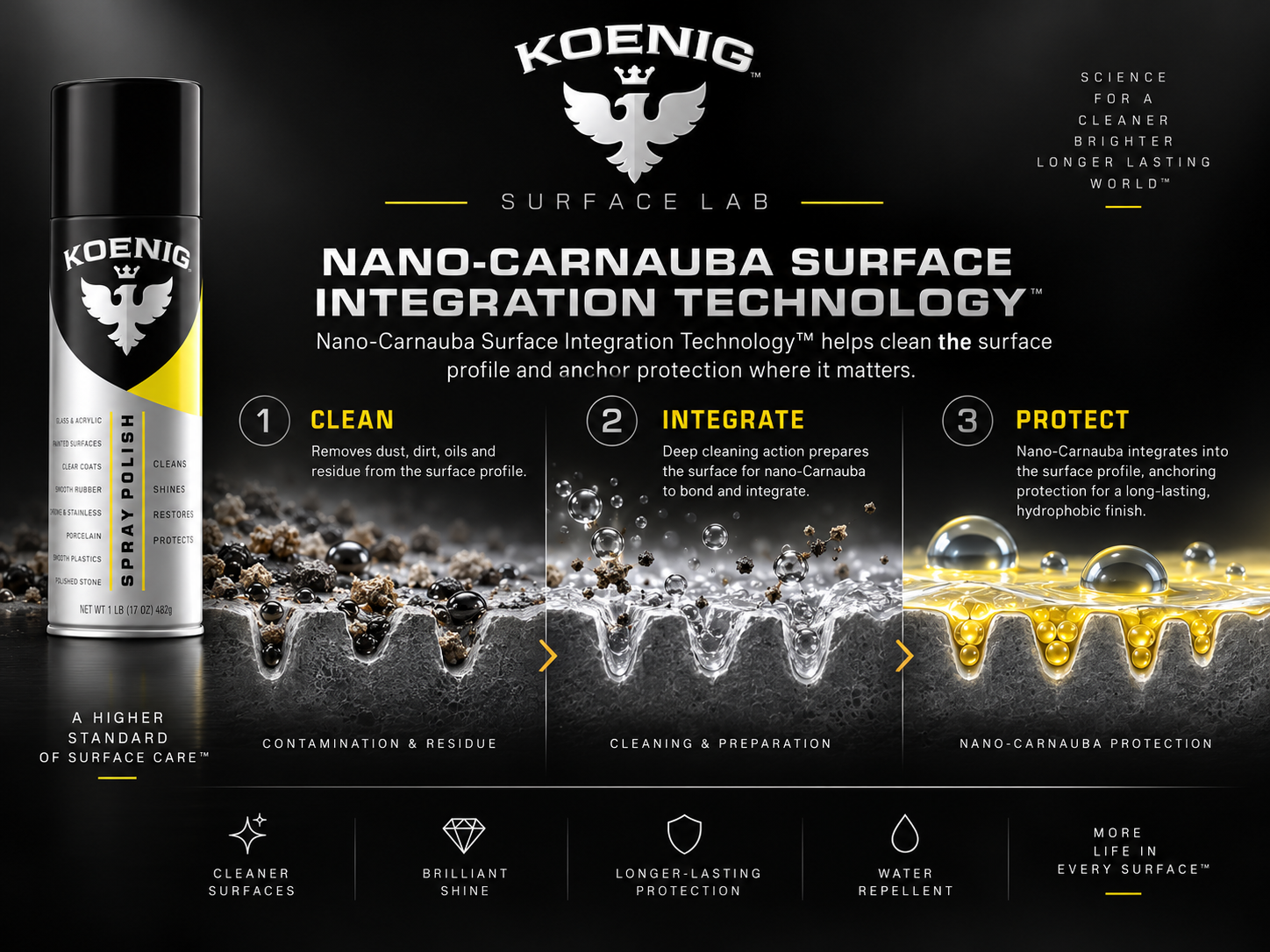
Real paint, gelcoat, glass, and metal finishes are not perfectly flat at microscopic scale. They contain peaks, valleys, scratches, defects, and other irregularities. Bonded contamination can occupy or bridge those features and interfere with how a protective treatment contacts the actual surface.
Remove bonded contamination so the protective phase can contact the actual surface rather than contamination sitting above it.
A fine Carnauba protective phase can follow microscopic highs, lows, scratches, and other surface irregularities more intimately than a heavy layer applied over contamination.
Close conformity allows the protective phase to occupy microscopic low areas and interact intimately with the real surface profile, increasing the opportunity for retention at the interface.
The finished surface presents a thin Carnauba-rich interface whose chemistry and microstructure influence gloss, feel, water behavior, cleaning ease, and durability.
Koenig Nano-Carnauba Surface Integration Technology™ is presented as Koenig’s branded working model for surface interaction. Surface Lab will separate measured findings from hypotheses and marketing shorthand as testing expands.